

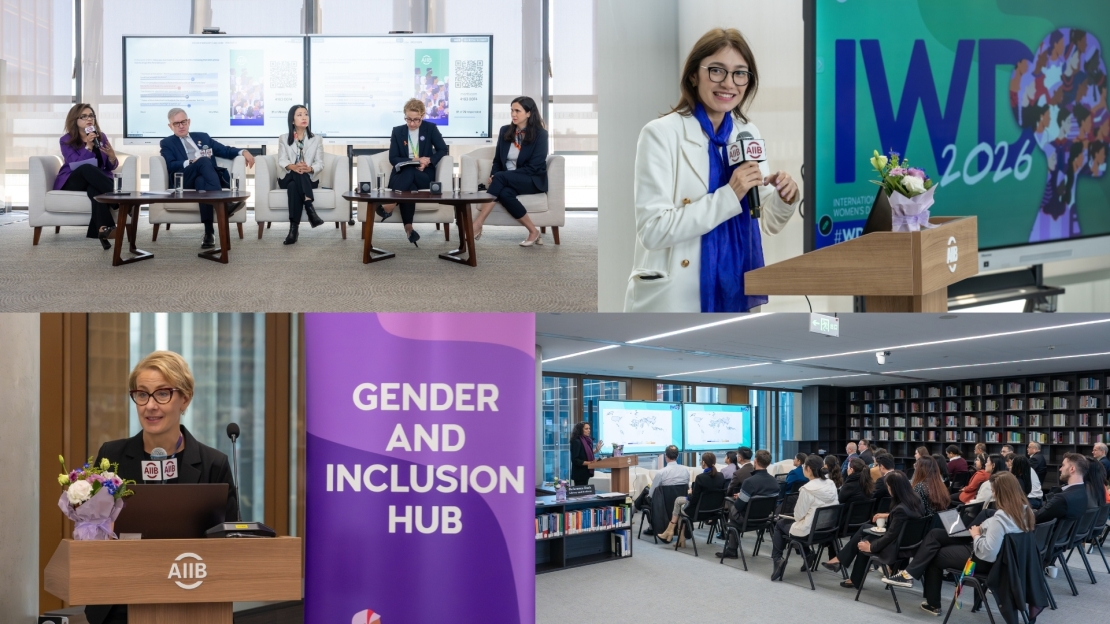
AIIB mobilized a Bank-wide effort anchored in International Women’s Day to strengthen how gender integration is understood and applied across the Bank’s operations and culture. Across two weeks in March, the Bank held a series of events under the theme “Inclusion4Impact” that focused on what matters most for an institution committed to gender equality: whether systems are in place to advance gender parity, teams are equipped with practical tools, knowledge is accessible to all, and the individuals driving this agenda are visible, connected and supported.
This effort reflects a broader shift in mindset. The conversation is no longer whether women belong in infrastructure or leadership but how AIIB can continue to build an environment where diverse perspectives consistently strengthen results. This shift was most evident in the flagship dialogue, “Inclusive Voices, Better Decisions,” which brought together senior leaders and staff to explore a critical but often overlooked challenge: how valuable perspectives can be unintentionally excluded due to hierarchy or meeting dynamics and what practical actions leaders can take to ensure that everyone is heard. It was also a moment to reflect on how far AIIB has progressed – from a time when women were underrepresented in decision-making to one where inclusion is increasingly embedded in how the Bank operates.
To translate these principles into practice, two targeted webinars complemented the dialogue. One equipped managers with practical approaches to mentoring and sponsorship, while the other focused on helping women across the Bank navigate workplace dynamics with confidence and authenticity.
The internal Inclusion4Impact Recognition campaign on Applause brought inclusion to life across the Bank. More than 100 recognitions were shared, celebrating colleagues who create space for others, amplify diverse perspectives and contribute to a culture of trust and respect. Beyond the numbers, the campaign reinforced a key message: inclusion is not only discussed, but actively practiced and appreciated across teams. According to AIIB Vice President for Investment Solutions Ajay Bhushan Pandey, “Inclusion is not something that can be added after the fact. It is a condition for a system to function effectively. If a system does not work for half of the population – for women – it is operating at only half of its potential.”
This message carried into the Gender Champions Panel, which demonstrated how leadership commitment translates inclusion principles into institutional practice. AIIB Gender Champions – recognized in 2025 for their leadership in integrating gender equality into investment operations – shared how gender‑lens financing delivers results when applied early, flexibly, and in partnership with clients. Drawing on examples from multiple sectors, the discussion highlighted real design choices, trade‑offs, and lessons learned in implementation. As Director General of AIIB’s Sustainability and Fiduciary Solutions Department Yanning Wang emphasized, “We can write the best guidance in the world. But guidance does not implement itself – people do. That is why at AIIB we invest in both: the tools that set the direction, and the communities that carry it forward.”
To support implementation, a set of practical tools was prepared and launched for internal use by operational teams, reinforcing the Bank’s corporate commitment to gender-lens financing and helping embed gender considerations throughout the project cycle.
AIIB also launched the Gender & Inclusion Hub – a staff-driven, cross-departmental initiative that emerged directly from the Bank’s 2025 “16 Days of Activism” campaign. Recognizing that knowledge, like infrastructure, is most powerful when built collectively and applied in practice, the hub brings together physical and digital resources on gender, diversity and culture, alongside research tools, multilateral development bank knowledge and multimedia content. AIIB Vice President and Chief Administration Officer Kaisu Christie noted, “None of us knows everything. But together – through books, research and conversation – we build the understanding that makes our investments more thoughtful and more just. Knowledge is infrastructure too, and this hub is our contribution to building it.”
Taken together, these initiatives mark not an endpoint but a transition as part of a longer journey – one where learning deepens, practice evolves and staff continue to shape how gender equality is embedded in both operations and institutional culture. The next phase will involve applying, adapting and sustaining these efforts – because inclusion, like development itself, is continuous, collective and always moving forward.