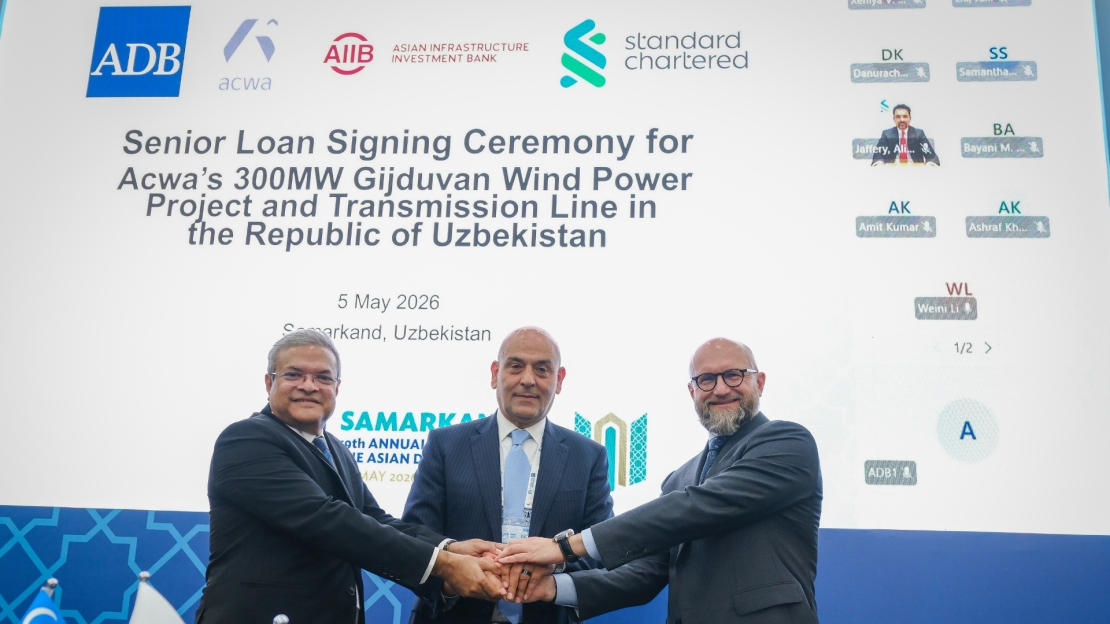


The Asian Infrastructure Investment Bank (AIIB) has signed a USD107 million loan agreement with private water-desalination company Acwa to support the development of the Bash 2 wind power plant in Uzbekistan.
The wind power plant, in the Gijduvan district of the Bukhara region, will have a renewable-energy capacity of 300 megawatts, contributing to Uzbekistan’s efforts to expand clean energy generation and diversify its energy mix. The plant is expected to generate about 943 gigawatt-hours of electricity annually, supplying power to more than 336,000 households and avoiding roughly 475,000 tons of carbon dioxide emissions. The project builds on the Bash 1 wind project and will be part of a broader renewable energy cluster in the region.
“AIIB’s investment in the Bash 2 wind power plant reflects our commitment to supporting Uzbekistan’s transition toward a more sustainable and diversified energy system,” said Konstantin Limitovskiy, AIIB’s Chief Investment Officer, Public Sector (Region 2) and Project and Corporate Finance Clients (Global). “By mobilizing private capital and partnering with experienced developers such as Acwa, the project contributes to scaling up renewable energy capacity while strengthening energy security and delivering long-term climate impact.”
Aligned with AIIB’s thematic priorities of green infrastructure, technology-enabled infrastructure and private capital mobilization, the operation also supports Uzbekistan’s goal of increasing the share of renewables in its power mix to 40% by 2030.
“Bash 2 represents a meaningful step forward in Acwa’s expanding partnership with Uzbekistan and the delivery of its energy transition ambitions,” said Abdulhameed AlMuhaidib, Acwa’s Chief Financial Officer. “As we expand our portfolio in Uzbekistan, it underscores the strength of well-structured public-private partnerships in mobilizing capital efficiently and delivering reliable, cost-competitive and clean power at scale. We are committed to deliver more for Uzbekistan to support achieving its power mix targets by 2030.”
The investment is backed by a long-term power purchase agreement with the National Electric Grid of Uzbekistan and co-financed with the Asian Development Bank and Standard Chartered Bank, underscoring investor confidence in the country’s renewable energy program.
Since 2019, AIIB and Acwa have built a growing partnership in Uzbekistan’s energy sector, with combined investments of approximately USD440 million across renewable and conventional energy generation, contributing to a more reliable and increasingly low-carbon power system.
More information about the project can be found here.
About AIIB
The Asian Infrastructure Investment Bank (AIIB) is a multilateral development bank whose mission is Financing Infrastructure for Tomorrow in Asia and beyond – infrastructure with sustainability at its core. AIIB began operations in 2016, now has 111 approved members worldwide, is capitalized at USD100 billion and is AAA-rated by major international credit rating agencies. AIIB collaborates with partners to mobilize capital and invest in infrastructure and other productive sectors that foster sustainable economic development and enhance regional connectivity.
About Acwa
Acwa (TADAWUL: 2082) is the world’s largest private water-desalination company, the first mover into green hydrogen and a leader in the global energy transition. Registered and established in 2004 in Riyadh, Saudi Arabia, Acwa’s portfolio comprises 111 projects across 15 countries in the Middle East, Africa, Central Asia and Southeast Asia, with assets under management of SAR455 billion (USD121 billion) and the capacity to generate 96 GW of power (of which 52.3 GW is renewables) and manage 9.8 million m³/day of desalinated water. The energy and water capacity generated by Acwa’s assets is delivered on a bulk basis to address the needs of state utilities and industries on long-term, offtaker contracts under utility services outsourcing and public-private partnership models.
For more information, visit www.acwapower.com